The Paiute cutthroat trout
The fish story
The Paiute cutthroat trout of Silver King Creek, from the first record of it, in 1890, to the federal review of 2025, told from the documents.
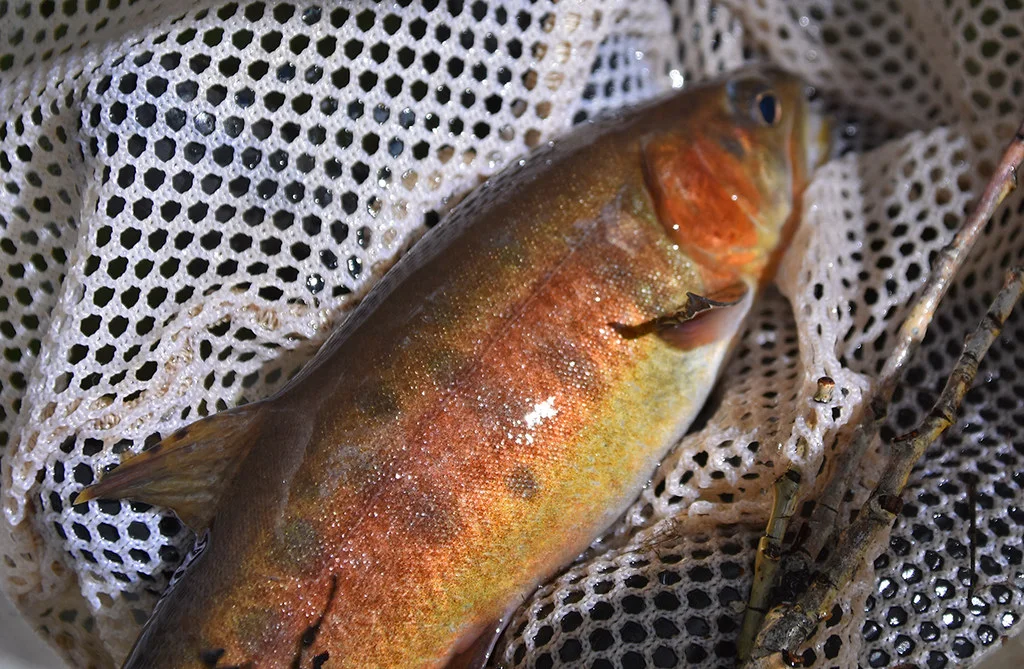
In September 1890 Virgil Connell, who was born and raised in Antelope Valley, and his schoolmate Harry Powell went into Fish Valley and camped where a little stream enters Silver King Creek. The Canadian wood choppers had moved out a few years before and left their equipment behind. “We found the creek literally alive with trout,” Connell wrote, fifty-four years later. In three days the boys took fifteen hundred home. Then they went exploring. “Above the falls we found there were no fish.” The fish had no name. When two state biologists, J. H. Ryan and S. J. Nicola, drew up its chronology in 1976, they began it with the woodcutters, “Trout transplanted by loggers to Corral Valley and Coyote Valley creeks,” and ended the entry with a question mark.
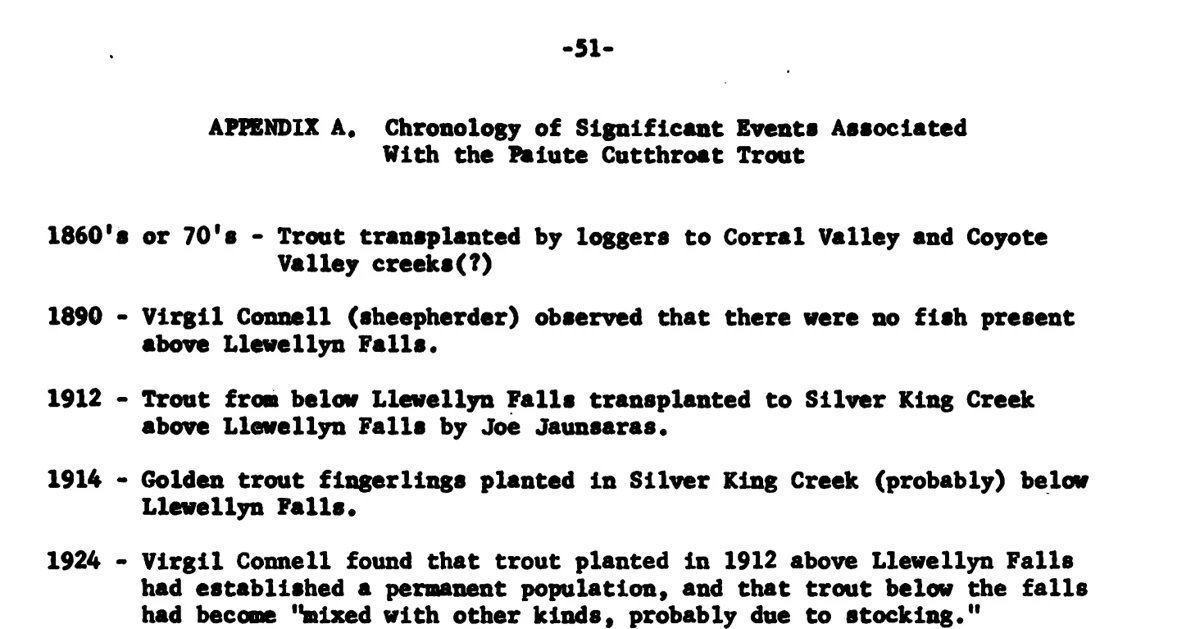
In 1893 Connell and Powell bought sheep, and Fish Valley became Connell’s summer range. “During the year 1912, a young Basque Joe Jaunsaras was herding for me, and while fishing just below the falls, and catching more than he wanted, he put some in a can and carried them above the falls.” By 1924, Connell wrote, “fishing above the falls was better than below.” Below the falls the fish had “become mixed with other kinds, probably due to the stocking on the lower stream of different varieties.”
Mrs. Lynn Llewellyn collected specimens and sent them to the State Division of Fish and Game. At nine in the morning on October 7, 1933, a small truck delivered live trout from the east side of the Sierra to the Steinhart Aquarium, in Golden Gate Park. That November John Otterbein Snyder, a Stanford ichthyologist, named them Salmo seleniris, “for a fancied resemblance of its evanescent tints to the lunar rainbow.” Of 79 of the fish taken above the falls that year, 47 had no spots on the body and the other 32 had from one to nine. Robert Behnke, working through the collections for his master’s thesis at Berkeley in 1960, put it plainly: “The Piute trout’s most distinctive character is an almost complete absence of spots on the body.” Snyder also took twenty fish below the falls. Behnke found “this sample was entirely of cutthroat-rainbow hybrids.” “It could not be ascertained,” he wrote, “if these hybrids were between introduced rainbows and the native henshawi of the Carson River or between rainbows and Piute trout which migrated over Llewellyn Falls, or perhaps all three.” In April 1934 California Fish and Game printed a painting of the fish by C. L. Starks as its frontispiece. That year the Fish and Game Commission closed Silver King Creek to angling.
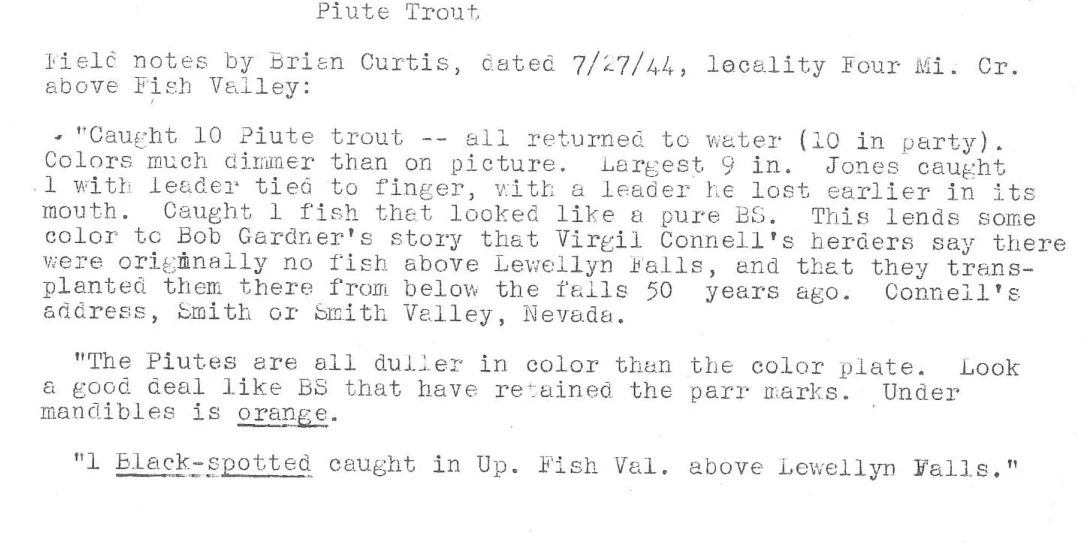
On July 27, 1944, Brian Curtis of the Division and his party caught ten Piute trout on Four Mile Creek, above Fish Valley, and returned all of them to the water. “Colors much dimmer than on picture,” he wrote. “Largest 9 in.” And: “The Piutes are all duller in color than the color plate.” In Upper Fish Valley, above the falls, the party caught one black-spotted trout. “This lends some color,” Curtis wrote, “to Bob Gardner’s story that Virgil Connell’s herders say there were originally no fish above Lewellyn Falls, and that they transplanted them there from below the falls 50± years ago.” His notes give the falls “an estimated 50 ft.” He had written to Connell, and Connell’s answer, three pages in his own hand, dated August 6, is the letter above. Curtis replied on August 9: “May I say that I envy you, your familiarity and long association with this part of the country.” In late October he interviewed Tom Jones, of Yreka, retired from the Forest Service in 1940, formerly of the Mono Forest. Jones had “planted 8 cans golden trout in Silver King Cr. in 1914,” Curtis noted, “but probably, from his description, below Lewellyn Falls. Thinks fish were present above L. Falls then.”
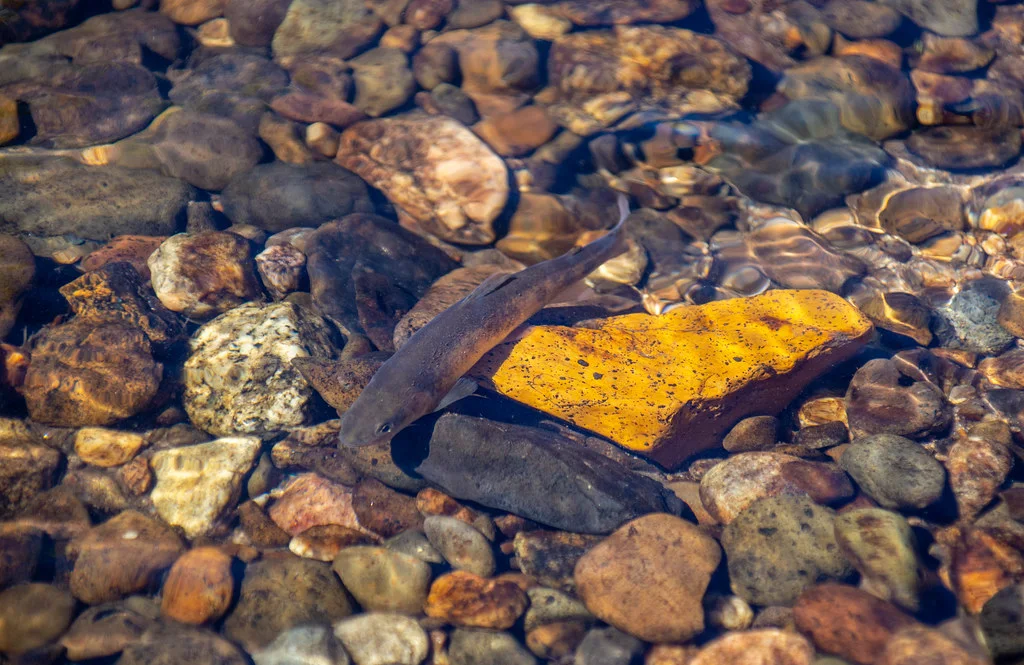
The fish matures at two and spawns in June and July. In a stream it seldom grows past ten inches; the largest recorded in Silver King Creek was 13.5. The federal recovery plan of 2004 calls Paiute cutthroat “less wary than other trouts, presumably because they evolved in a high mountain environment where terrestrial and avian predators are not frequently encountered.” “Their unwariness makes them highly vulnerable to angling.”
By 1946 poachers had decimated the fish in Upper Fish Valley, by the Division’s account. Elden H. Vestal and a crew caught 407 trout on August 21 and 22, in Upper Fish Valley and in Coyote and Corral valleys, carried them in pack cans, and the next day planted 401 in the North Fork of Cottonwood Creek, in the White Mountains, a stream “barren of fishlife.” The temperature in the cans varied one degree Fahrenheit.
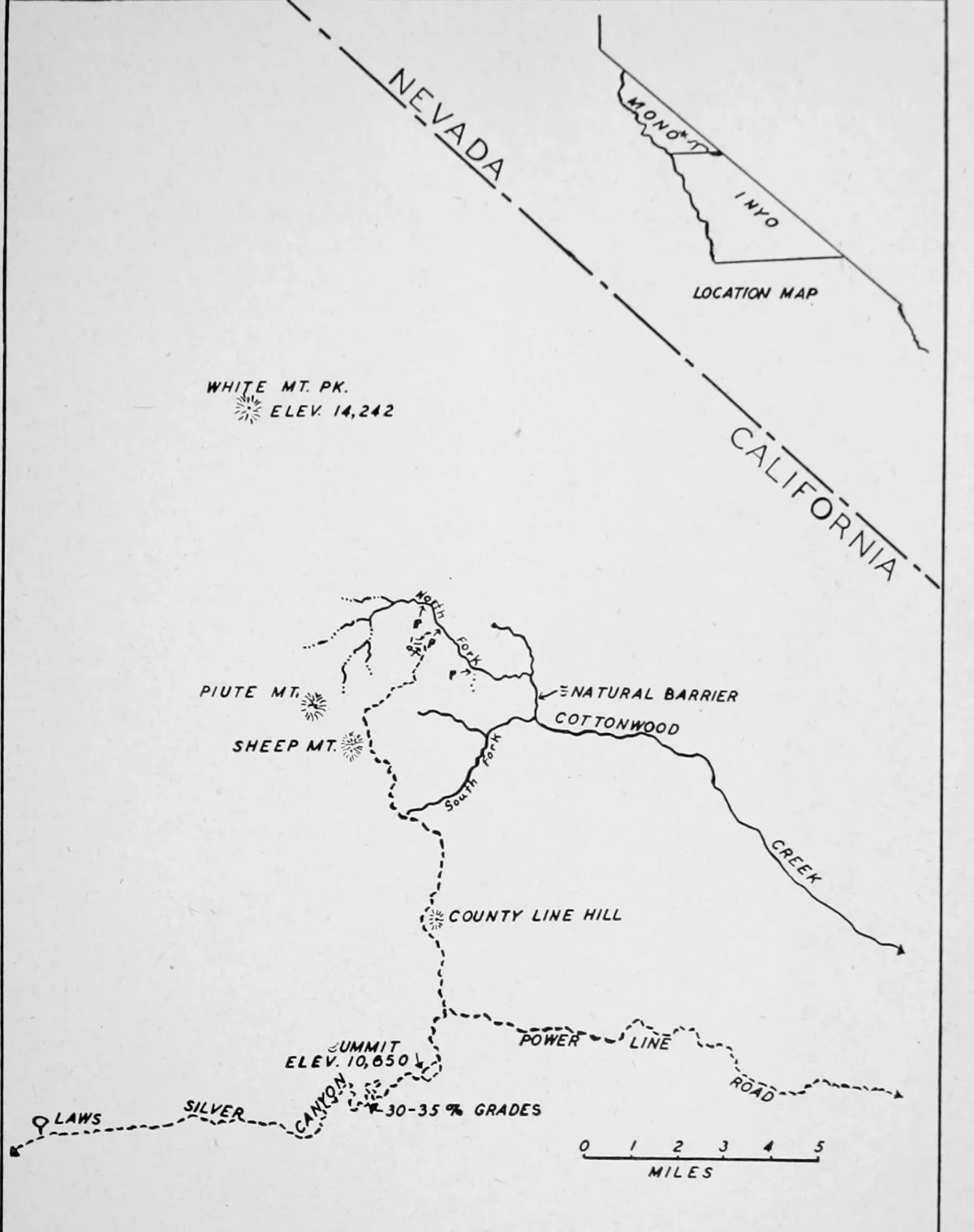
On September 30, 1949, an employee of the Division planted 5,040 rainbow trout above Llewellyn Falls, “without authorization,” Ryan and Nicola wrote. In 1952 the Commission reopened Silver King Creek to angling. Behnke measured fourteen fish taken there in 1956 and found them larger and deeper-bodied than Snyder’s, a change that “might be attributed to an increased fishing pressure on the tiny stream, after it was opened to public fishing in 1952, and the resulting reduction of the population.” A survey in 1963 found the fish above the falls “badly depleted and composed of numerous heavily spotted individuals.” The Department poisoned the creek in Upper Fish Valley in 1964, and in 1965 the Commission closed it again above the falls. On March 11, 1967, the Secretary of the Interior listed the Paiute cutthroat as endangered. On July 16, 1975, it was reclassified as threatened.
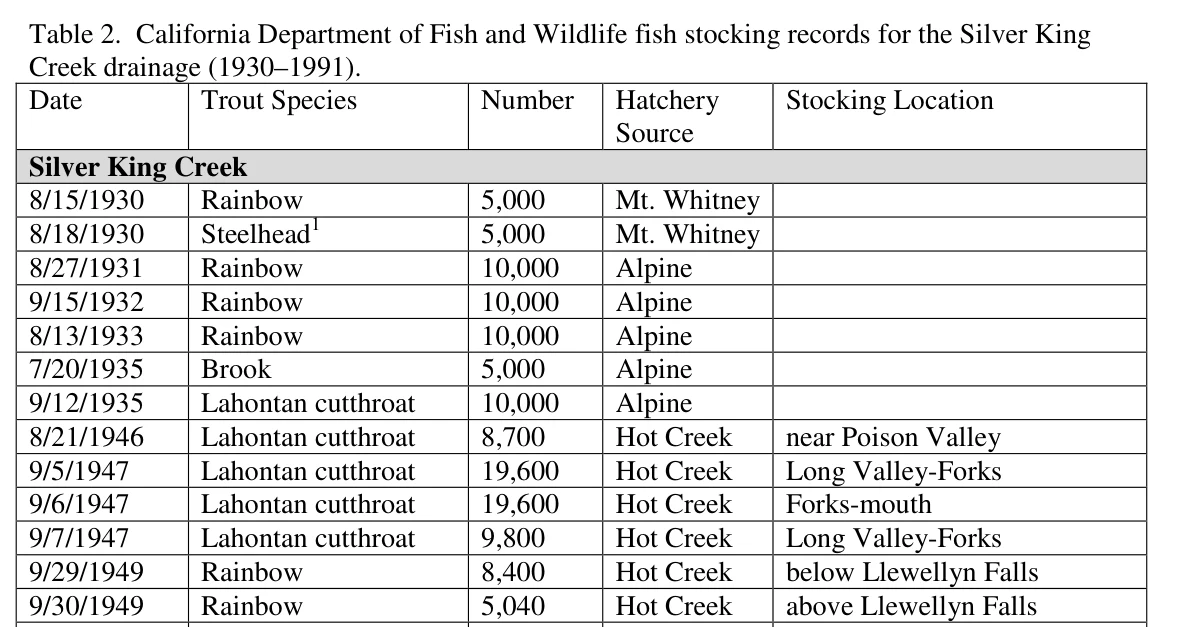
The poisoning above the falls did not hold until a three-year treatment, 1991 through 1993. Below the falls, Leo Cronin, president of the North Bay Chapter of Trout Unlimited, hiked in through the 1980s and 1990s to restore habitat on lower Silver King Creek. He died in 1995. Ten years later the agencies were ready to treat the eleven miles below the falls. In 2019 Stafford Lehr, of the Department, told the Reno Gazette-Journal where he had been: “Sitting in 2005 with all the equipment ready to go less than 10 hours from starting the project and getting a satellite phone call telling me, stand down, because the judge had issued an order.” He had sixty people in the field. On August 31, 2005, the U.S. District Court had granted a temporary restraining order. On September 1 it granted an injunction.
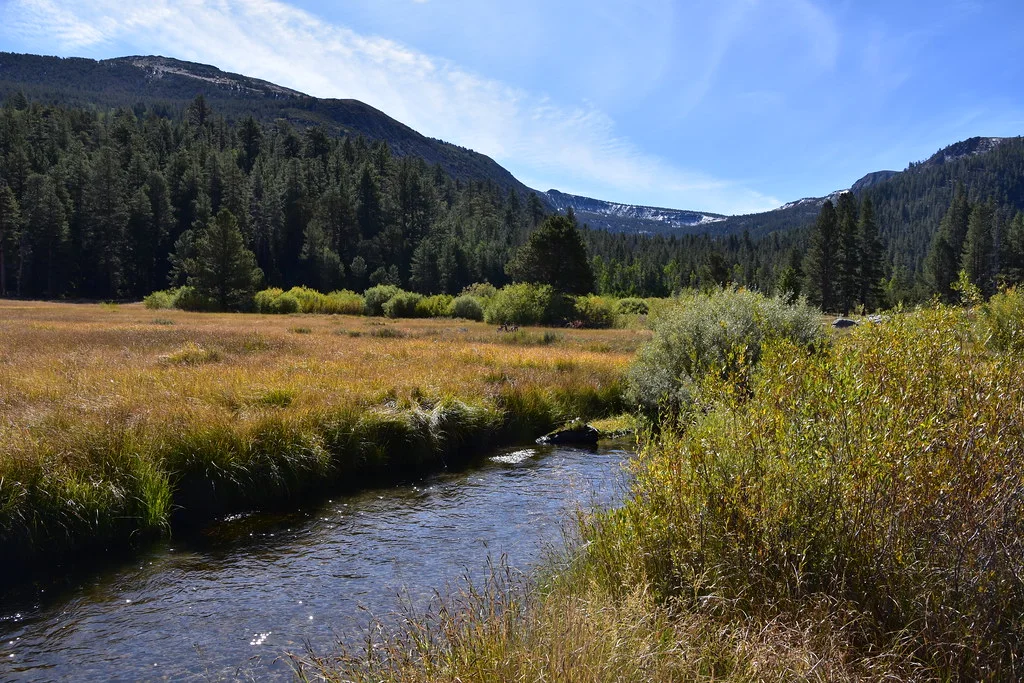
The treatment ran from 2013 to 2015. The drought of 2012 to 2016 froze Silver King Creek in Upper Fish Valley almost solid, and the fish there declined. In August 2017 a crew electrofished 86 Paiute cutthroat from the North Fork of Cottonwood Creek, the descendants of Vestal’s 401, packed them out by mule, drove them about a hundred miles, and packed them in again in milk cans. They were released above Llewellyn Falls on August 23. Every fish survived the trip.
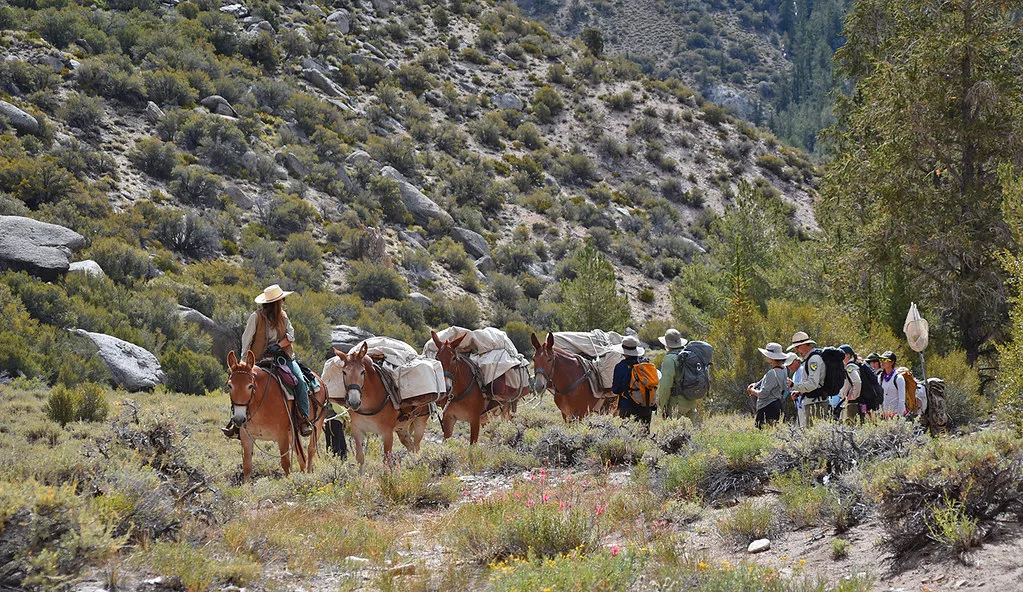
On September 18, 2019, the fish went back into the miles below the falls. Chuck Bonham, director of the Department, released one. Michael Cronin, Leo’s son, released another. They came the last miles on Joe Cereghino’s mules, from the Little Antelope Pack Station, and went to the water in white buckets.
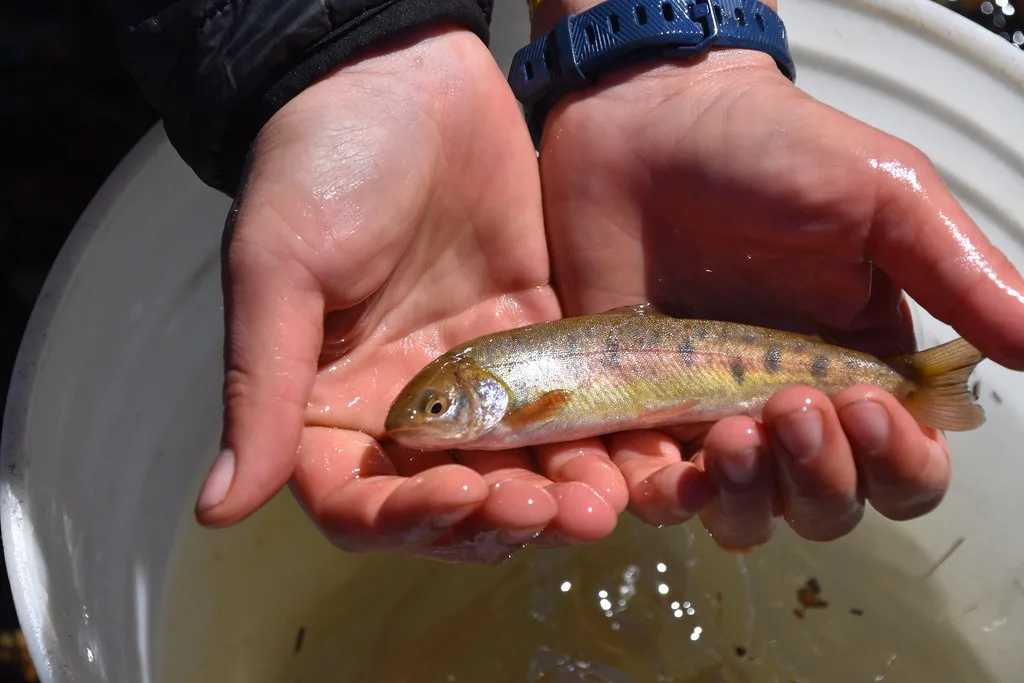
How long the fish has been a fish of its own is not settled. In 1976 Behnke and M. Zarn put its separation from the Lahontan cutthroat at “no more than 5,000 to 8,000 years ago,” after Lake Lahontan dried. In 2017 a genetic study by I. K. Saglam and others, as the Fish and Wildlife Service summarized it in 2020, suggested the two “diverged from each other substantially longer than previously thought.”
The federal five-year review signed on August 25, 2025, keeps the fish as threatened and makes no recommendation on its status. In its table of populations, the entry for Silver King Creek above the falls begins: “Originally stocked by stockmen in 1912.”